
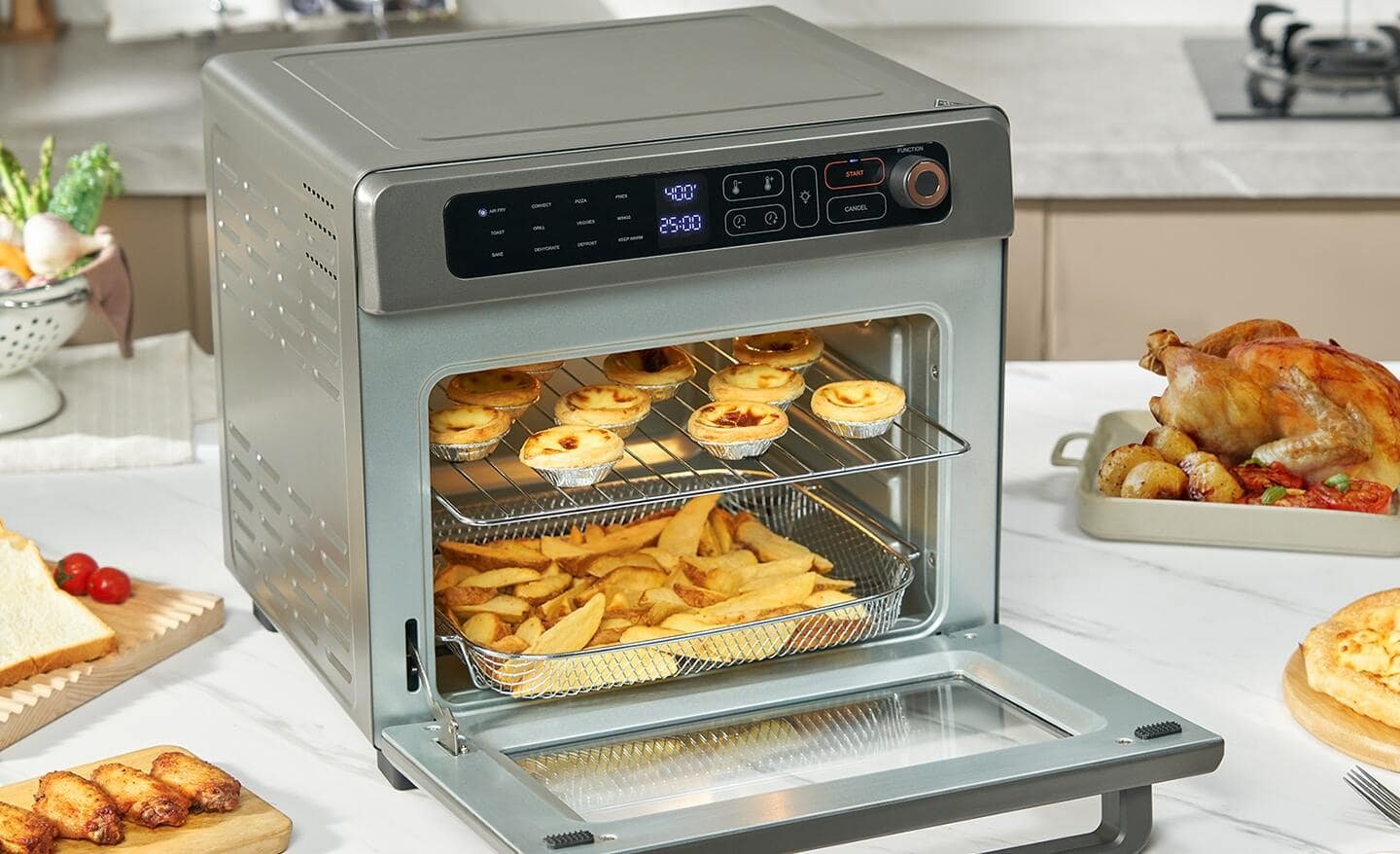
Is An Air Fryer A Convection Oven: Key Differences
Yes. An air fryer is essentially a compact convection oven, but it is designed to circulate hot air more rapidly around a smaller cooking chamber. That concentrated airflow helps brown and crisp foods, often with less oil than traditional frying.
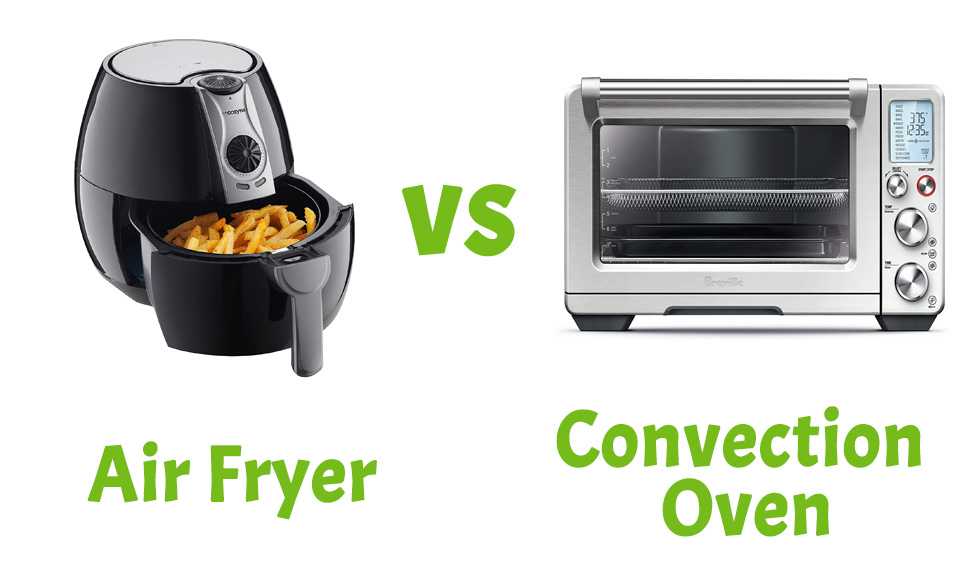
The terms are not completely interchangeable, though. A full-size convection oven offers more capacity and flexibility, while an air fryer usually cooks smaller portions faster and may produce crispier results for foods such as French fries, chicken wings, and breaded vegetables.
This guide explains how air fryers work, how they differ from convection ovens, when to use each appliance, and how to convert oven recipes safely.

What Is an Air Fryer?
An air fryer is a small countertop appliance that cooks food with heated, rapidly circulating air. Most models include a heating element, a fan, and a perforated basket or rack that allows air to move around the food.
The cooking process is a form of convection cooking. Instead of submerging food in oil, the appliance transfers heat through moving air. A small amount of oil can improve browning, but many foods do not require oil at all.
How an air fryer works
An air fryer typically:
- Heats air with an electric heating element.
- Uses a fan to circulate the hot air.
- Directs airflow around and beneath the food.
- Removes moisture from the food’s surface.
- Encourages browning and crisping through surface dehydration and the Maillard reaction.
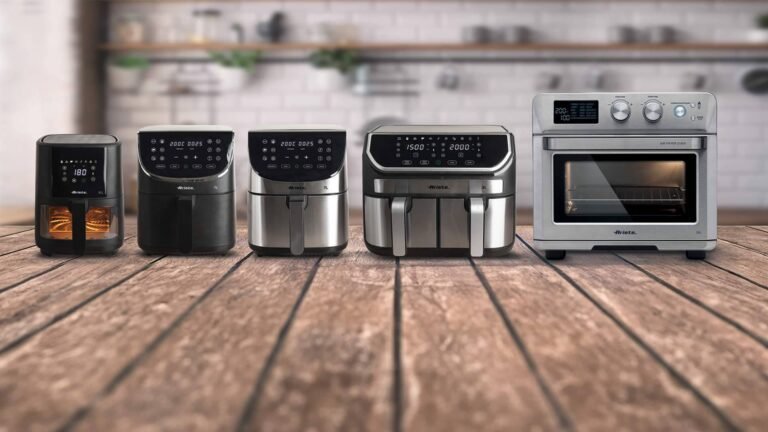
The exact design varies. Basket-style air fryers usually have a compact cooking chamber and a perforated basket. Air-fryer toaster ovens may use racks, trays, and a broader horizontal cooking area.
Is “air frying” the same as deep-frying?
No. Air frying and deep-frying use different heat-transfer methods.
| Cooking method | Main heat source | Oil requirement | Typical result |
|---|---|---|---|
| Deep-frying | Hot oil surrounding the food | High | Very crisp exterior and rich texture |
| Air frying | Rapidly circulating hot air | Little or none | Crisp, browned exterior with a lighter surface |
| Conventional baking | Still or gently moving hot air | Little or none | Evenly cooked, but often less crisp |
| Convection baking | Fan-circulated hot air | Little or none | Faster browning and more even heat distribution |
An air fryer can imitate some characteristics of fried food, but it does not reproduce the same texture in every recipe. Wet batters, for example, may not set as they would in hot oil unless the food has a suitable coating.

Why Is an Air Fryer Considered a Convection Oven?
An air fryer qualifies as a type of convection oven because it cooks by circulating heated air around the food. The main distinction is not the basic cooking principle; it is the appliance’s size, airflow pattern, heating layout, and intended use.
A conventional oven may use natural airflow or a fan. A convection oven adds a fan to move hot air throughout a larger cavity. An air fryer applies a similar principle in a smaller space, often with more concentrated airflow.
The role of the fan
The fan moves hot air across the food’s surface. This can:
- Speed up heat transfer.
- Promote faster browning.
- Reduce temperature differences within the cooking chamber.
- Remove surface moisture more effectively.
- Shorten cooking time for small portions.
Airflow is one reason air fryers can make frozen foods and roasted vegetables crisp without much oil. However, fan speed and air direction differ by model, so cooking results are not identical across brands or appliance types.
Why the small chamber matters
A smaller cavity generally allows the appliance to heat quickly and keep the food close to the heating element and fan. That can make the air fryer efficient for small servings.
The same compact design creates limitations:
- Large foods may not fit.
- Food can become crowded easily.
- Multiple batches may be necessary.
- The basket may need shaking or turning.
- Tall or delicate foods may not cook evenly.
An air fryer is therefore best understood as a specialized, compact convection appliance, rather than a complete replacement for every function of a full-size oven.
Are all air fryers convection ovens?
Most traditional basket-style air fryers and air-fryer toaster ovens use convection airflow. Some combination appliances may also include microwave, broiling, dehydrating, steaming, or other cooking modes. Those additional functions do not change the fact that their air-fry setting generally relies on heated air and a fan.
To verify how a particular model works, check the manufacturer’s manual for terms such as:
- Convection fan
- Air-fry fan
- Rapid air circulation
- Convection roast
- Air-fry basket or perforated tray
Marketing terms vary, so the manual is more reliable than the product name alone.

Air Fryer vs. Convection Oven: What Is the Difference?
The biggest difference is practical: an air fryer prioritizes fast, concentrated airflow and small portions, while a convection oven prioritizes capacity and versatility.
| Feature | Air fryer | Full-size convection oven |
|---|---|---|
| Cooking chamber | Small | Medium to large |
| Preheating | Often short or unnecessary for some recipes | Usually takes longer |
| Airflow | Highly concentrated | Distributed across a larger cavity |
| Best for | Small portions and crisping | Family meals, baking, roasting, and large dishes |
| Capacity | Limited | Much greater |
| Energy use per small batch | Often lower, depending on model and cooking time | May be less efficient for a small portion |
| Multiple racks | Limited or model-dependent | Common |
| Cooking flexibility | Moderate | High |
| Food handling | Basket shaking or turning may be needed | Usually less frequent handling |
Cooking speed
An air fryer may cook a small portion faster because it has a compact cavity and strong airflow. That does not mean every air fryer recipe will always cook faster than an oven recipe. Cooking time depends on:
- Food thickness
- Starting temperature
- Quantity
- Basket fullness
- Appliance wattage
- Temperature setting
- Whether the food is frozen or thawed
- Whether the appliance was preheated
Use visual doneness and a food thermometer where appropriate rather than relying only on a time conversion.
Crispness
Air fryers often excel at crisping exposed surfaces. Their perforated baskets let heated air reach more of the food, while a baking sheet in a conventional oven can shield the bottom surface.
For the best texture:
- Leave space between pieces.
- Avoid covering the basket with solid foil.
- Shake or turn food when the recipe calls for it.
- Dry wet ingredients before cooking.
- Use only enough oil to lightly coat the surface.
Crowding traps moisture and can produce soft or unevenly browned food.
Capacity
A full-size convection oven is better for:
- A whole turkey or large roast
- Several trays of cookies
- Large casseroles
- Multiple servings of vegetables
- Bread and other baked goods that need room to expand
An air fryer is better suited to:
- One or two servings
- Frozen snacks
- Chicken wings
- Reheating pizza or fried food
- Small batches of vegetables
- Toasted nuts and similar foods
Capacity labels can be misleading because a basket may technically hold a large quantity while still producing better results in a single layer. The usable capacity depends on how much space food needs for airflow.

Can You Use an Air Fryer Recipe in a Convection Oven?
Yes, but the result may require adjustments. Since both appliances use circulating hot air, an air-fryer recipe can often be adapted for a convection oven. However, a full-size oven usually has a larger cavity and less concentrated airflow around each piece of food.
A practical starting point is to use the same temperature and begin checking the food earlier than the recipe’s stated time. If the recipe was developed specifically for a powerful basket-style air fryer, the convection oven may need more time or a different rack position.
Air fryer to convection oven conversion
There is no universal conversion formula because appliance designs vary. As a starting point:
- Use a convection setting rather than a conventional bake setting.
- Spread food in a single layer on a perforated tray or wire rack when possible.
- Place a sheet pan beneath the rack to catch drips.
- Begin checking several minutes before the stated cooking time.
- Turn or rotate food if browning is uneven.
- Confirm doneness with a thermometer for meat, poultry, and seafood.
A hypothetical example: If frozen potato wedges are listed at 400°F in an air fryer for 15 minutes, a convection oven might use approximately the same temperature but require a longer cooking period. Check the wedges early, turn them, and continue until they are browned and hot throughout.
That example is not a guaranteed formula. Frozen food size, brand, tray design, and oven calibration can change the result.
Convection oven to air fryer conversion
For a conventional or convection oven recipe, many cooks start by reducing the temperature by about 25°F or shortening the cooking time. This is only a starting point, not a rule for every recipe.
A more reliable approach is:
- Keep the recipe temperature if the food is delicate or requires a specific baking structure.
- Reduce the quantity to fit the basket without crowding.
- Start checking earlier.
- Turn or shake the food when needed.
- Monitor browning closely.
- Use the recipe’s internal temperature or texture requirements to determine doneness.
Delicate baked goods, large roasts, custards, and foods with wet batters may not adapt well to a basket air fryer.

Which Is Better: An Air Fryer or a Convection Oven?
Neither appliance is universally better. The right choice depends on portion size, available space, cooking habits, and the type of food you prepare.
Choose an air fryer when you want to:
- Cook one or two servings quickly.
- Crisp frozen foods or leftovers.
- Roast small quantities of vegetables.
- Reduce the need for added oil.
- Avoid heating a large oven for a small meal.
- Use a compact appliance in a kitchen with limited space.
Choose a convection oven when you need to:
- Cook for several people.
- Bake on multiple racks.
- Prepare large dishes.
- Roast substantial cuts of meat.
- Use standard baking pans and casserole dishes.
- Cook foods that need more vertical or horizontal space.
Some US homes have a range or wall oven with a built-in convection or air-fry setting. In that situation, the oven may offer air-frying capability without requiring another countertop appliance. The performance depends on fan strength, tray design, rack position, and the manufacturer’s instructions.
Does an air fryer use less electricity?
An air fryer may use less total energy for a small meal because it has a smaller cavity and often a shorter cooking time. However, energy use depends on the appliance’s wattage, run time, preheating, and the amount of food being cooked.
For example, an air fryer may be practical for reheating two slices of pizza, while a full-size oven may make more sense for a large casserole or several trays of food. The most efficient choice depends on the quantity rather than the appliance category alone.
Are air fryers healthier than convection ovens?
The appliance itself does not determine whether a meal is healthy. Both appliances can cook food with little added oil, but nutrition depends on the ingredients, portion size, preparation method, and overall diet.
Air frying may reduce the amount of oil used compared with deep-frying. It does not automatically make highly processed foods nutritious, and it does not eliminate calories, sodium, or saturated fat already present in the food.
How to Use an Air Fryer Like a Convection Oven
Use an air fryer as a compact convection oven by managing airflow, food quantity, temperature, and cooking time.
Step 1: Read the appliance manual
Check the manual for:
- Maximum fill lines
- Safe temperatures
- Rack and basket placement
- Preheating instructions
- Approved cookware
- Cleaning directions
- Restrictions on parchment paper and aluminum foil
Manuals differ by model. A setting or accessory that is safe in one appliance may not be suitable for another.
Step 2: Arrange food for airflow
Place food in a single layer when crispness matters. Small gaps allow hot air to contact more of the surface.
If you must stack food, use a rack designed for that model and shake or rotate the food during cooking. Avoid blocking the fan or heating element.
Step 3: Add oil carefully
Use a light coating when needed. Oil can help dry surfaces brown, but excess oil may smoke, drip into the heating area, or create an unnecessarily greasy result.
Never pour oil into the bottom of a basket-style air fryer unless the manufacturer specifically permits it.
Step 4: Adjust temperature and time gradually
Start with the recipe’s recommended temperature, then inspect the food earlier than you would in a full-size oven. Make small adjustments rather than immediately applying a large temperature reduction.
Step 5: Verify doneness
For foods that require a safe internal temperature, use a food thermometer. The USDA recommends:
- 165°F for poultry, leftovers, and casseroles
- 160°F for ground meats
- 145°F, followed by a three-minute rest, for whole cuts of beef, pork, veal, and lamb
- 145°F for fish, measured in the thickest part
These temperatures come from USDA food-safety guidance, but cooking instructions for a particular product may also specify handling requirements.
Step 6: Clean the appliance after it cools
Remove food residue and grease according to the manual. Unplug the appliance before cleaning the heating area, and do not immerse an electrical base in water.

Common Air Fryer and Convection Cooking Mistakes
Most poor results come from restricted airflow, incorrect timing, or unsuitable cookware rather than from a fundamental problem with the appliance.
Overcrowding the basket
A crowded basket prevents air from reaching the food evenly. The outside may brown while the center remains soft.
Better approach: Cook in batches or use a larger convection tray when the portion is too large.
Covering the basket completely
Solid foil or parchment can block airflow and may move into the heating element if it is not secured by food. Some air-fryer parchment products are perforated specifically for airflow.
Better approach: Follow the manual, use perforated accessories when approved, and never place loose paper in a preheating appliance.
Using wet batter
Traditional wet batter can drip through a basket before it sets. It may also fail to develop the same shell produced by deep-frying.
Better approach: Use a dry coating, a breaded coating that adheres well, or a recipe specifically developed for air frying.
Ignoring the heating element
Grease and food particles near the heating element can create smoke or unpleasant odors.
Better approach: Let the appliance cool fully, then clean it as directed. If smoke continues, stop using the appliance and inspect it for residue, damage, or an unsuitable cooking temperature.
Treating every air fryer as identical
Two appliances set to the same temperature can produce different results because of differences in basket shape, fan speed, heating element position, and temperature calibration.
Better approach: Treat published times as starting points and keep notes for foods you prepare often.
Using unsafe or unsuitable cookware
Some glass, ceramic, plastic, or silicone products may not tolerate air-fryer temperatures or direct heating. The cookware may also restrict airflow.
Better approach: Use accessories labeled for the appliance’s temperature range and follow both the cookware and appliance instructions.
Forgetting ventilation and clearance
Air fryers release hot air and need space around their vents. Placing one directly beneath cabinets or against a wall can create heat and moisture problems.
Better approach: Keep the appliance on a stable, heat-resistant surface with the clearance specified in the manual.

Frequently Asked Questions
Is an air fryer just a small oven?
An air fryer is a small convection oven designed for rapid air circulation and crisping. It is an oven in terms of its cooking method, but its basket, airflow, capacity, and controls are specialized for small portions.
Can I use aluminum foil in an air fryer?
Often, but only when the manufacturer’s instructions allow it. Foil must not block necessary airflow, cover the entire basket, touch the heating element, or remain loose where the fan could move it. Never use foil as a substitute for following the appliance manual.
Do air fryers need preheating?
Some recipes benefit from preheating, especially when a crisp exterior or precise cooking time matters. Other foods can begin in a cold appliance. Follow the recipe and manual, and remember that preheating may affect cooking time.
Can I bake in an air fryer?
Yes, if the container fits and is rated for the appliance’s temperature. Air fryers can bake small cakes, muffins, biscuits, and other foods, although the shape and capacity of the basket may limit results. Use a suitable pan and allow room for air circulation.
Is an air fryer better than a toaster oven?
It depends on the task. A basket air fryer often cooks small portions quickly and crisps them effectively. A toaster oven generally provides more usable space and can accommodate standard pans, toast, broiling, and baking. Air-fryer toaster ovens combine some of these functions but may require longer preheating and more counter space.
Key Takeaways
- An air fryer is a compact convection oven, not a fundamentally different type of heat-based appliance.
- Its small chamber and concentrated airflow can cook and crisp small portions quickly.
- A full-size convection oven offers more capacity and flexibility.
- Recipe conversions require judgment because fan speed, basket design, food quantity, and temperature accuracy vary.
- Avoid crowding the basket, blocking vents, and using unapproved cookware.
- Use a food thermometer for meat, poultry, seafood, casseroles, and leftovers when safe internal temperature matters.
Conclusion
An air fryer is best described as a specialized countertop convection oven. It uses heated, moving air rather than a large volume of cooking oil, and its compact design makes it especially useful for crisping small portions.
Choose an air fryer for quick servings, reheating, frozen foods, and small batches of roasted ingredients. Choose a full-size convection oven when you need capacity, multiple racks, standard baking pans, or a large meal. For either appliance, airflow and food temperature matter more than the label on the control panel.


One Comment